A00Opening
Ware Opening
1. a4
Black to move
- Legal moves
- 20
- Games in the next 4 moves
- 217,832
- Different positions among them
- 78,841
- Named lines from here
- 6
Named after the American player Preston Ware. 1. a4 does little for the centre and is among the least played first moves.
It is reached after a single move: 1. a4.
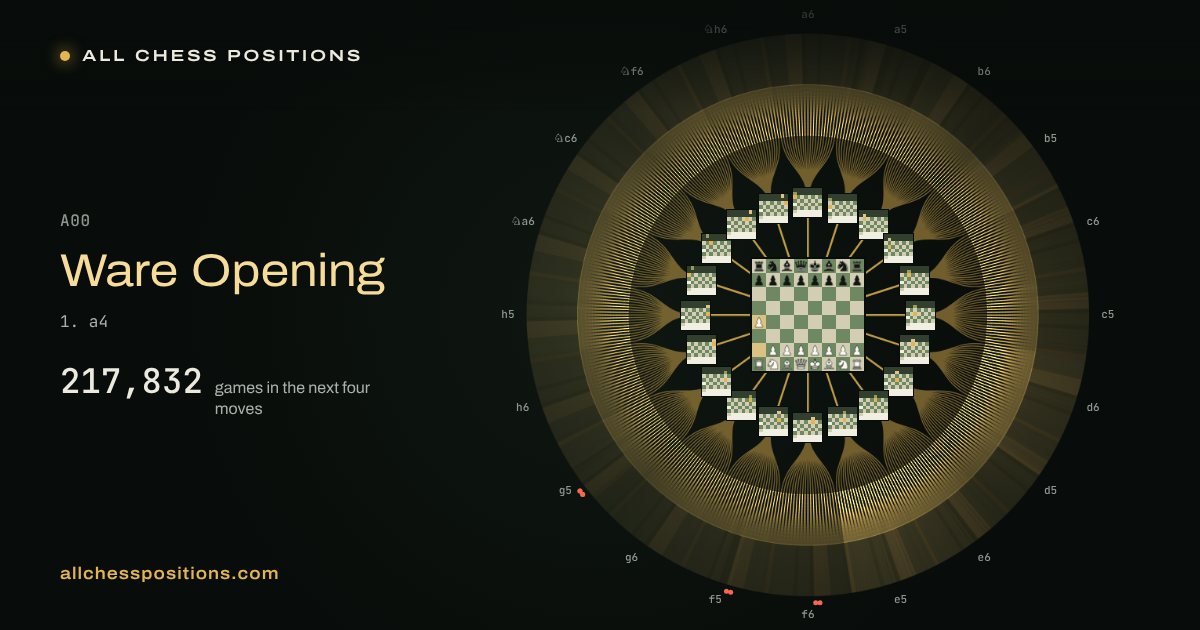
Black is to move and has 20 legal moves. Over the next four moves — two for each side — the game can branch into 217,832 different games. Those games reach 78,841 different positions: most positions can be reached in more than one way, 2.8 on average.
The Lichess opening list names 6 further lines after this position, such as Symmetric Variation (1... a5) and Crab Variation (1... e5 2. h4).
What Stockfish says
Stockfish 19 scores this position at −0.13 for White: the game is level. The search looked at 20 million positions (nodes) and reached depth 39. Its best line: 1... Nf6 2. d4 e6 3. Nf3 c5 4. e3 Nc6 5. Bd3.
| Reply | Name | Score |
|---|---|---|
| 1... Nf6 engine’s choice | — | −0.13 |
| 1... e5 | — | −0.06 |
| 1... b6 | — | +0.13 |
| 1... a5 | Symmetric Variation | +0.38 |
| 1... b5 | — | +1.33 |
Scores are from White’s point of view, in pawns: + means White is better. The other replies are scored with 2 million nodes each, the engine’s choice with the 20 million of the position above, so differences under about 0.3 are within the engine’s noise. All twenty first moves, ranked by Stockfish.
Move by move
- 1. a4Ware Opening
Named lines from here
- Symmetric VariationA001... a5
- Crab VariationA001... e5 2. h4
- Meadow Hay TrapA001... e5 2. Ra3
- Wing GambitA001... b5 2. axb5 Bb7
- Cologne GambitA001... b6 2. d4 d5 3. Nc3 Nd7
- Ware GambitA001... e5 2. a5 d5 3. e3 f5 4. a6
Related openings
- King's Pawn GameB001. e4
- Queen's Pawn GameA401. d4
- English OpeningA101. c4
- Zukertort OpeningA041. Nf3
- Bird OpeningA021. f4
- Nimzo-Larsen AttackA011. b3
- Hungarian OpeningA001. g3
- Polish OpeningA001. b4
- Van Geet OpeningA001. Nc3
- Van't Kruijs OpeningA001. e3
Chess by the numbers
FEN
rnbqkbnr/pppppppp/8/8/P7/8/1PPPPPPP/RNBQKBNR b KQkq - 0 1