Chess by the numbers
How many possible chess games are there?
About 10120, by Claude Shannon’s famous estimate; nobody knows the exact number of complete games, and under today’s rules, which end every game sooner or later, the total lies somewhere between about 1029,241 and 1034,082. The first moves can be counted exactly: after one move each there are 400 possible games; after two moves each, 197,281; after five moves each, 69,352,859,712,417.
Counting move by move
Here a “move” is one turn by one player, so after 2 moves both sides have moved once. A “game” is any legal sequence of moves; two games that reach the same position by different routes still count twice (for positions, see how many chess positions there are).
| Moves played | Possible games |
|---|---|
| 1 | 20 |
| 2 — one move each | 400 |
| 3 | 8,902 |
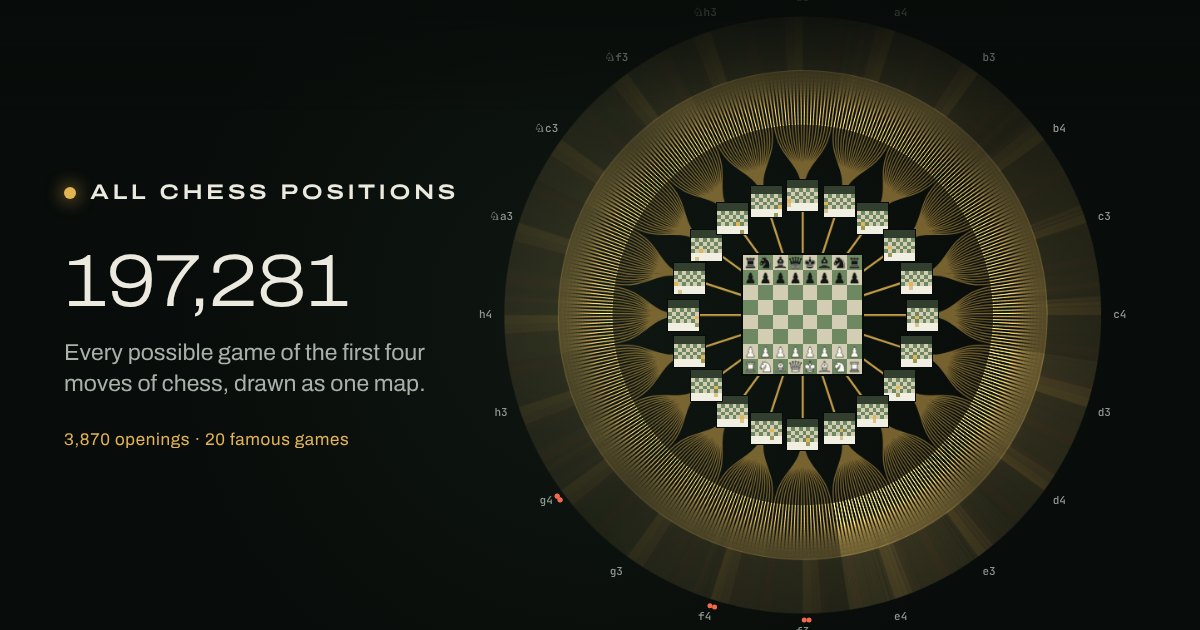
| 4 — the map shows all of these | 197,281 |
| 5 | 4,865,609 |
| 6 | 119,060,324 |
| 7 | 3,195,901,860 |
| 8 | 84,998,978,956 |
| 9 | 2,439,530,234,167 |
| 10 — five moves each | 69,352,859,712,417 |
| 11 | 2,097,651,003,696,806 |
| 12 | 62,854,969,236,701,747 |
| 13 | 1,981,066,775,000,396,239 |
| 14 | 61,885,021,521,585,529,237 |
| 15 | 2,015,099,950,053,364,471,960 |
Each extra move multiplies the count by about 20 at first and by more than 30 later, as the pieces come out and have more squares to go to. The first four moves are small enough to draw: the map shows every one of the 197,281 games around the starting position, and around any position you play.
Whole games: the Shannon number
In 1950 the mathematician Claude Shannon estimated that a typical game offers about a thousand possibilities for each pair of moves and lasts about forty such pairs, which gives roughly 10120 games — the Shannon number. Later estimates are in the same spirit: Victor Allis put the game-tree complexity of chess at no less than 10123.
Is the number finite?
Under today’s FIDE rules it is: since 2014 a game ends automatically after 75 moves by each side without a capture or a pawn move, or when the same position appears five times. François Labelle worked out that the longest possible game is then 8,848½ moves long, and that the number of possible games lies between about 1029,241 and 1034,082.
How long would counting take?
Exact counts exist up to 15 moves, where there are 2,015,099,950,053,364,471,960 games. Even at a hundred million games a second — a fast computer — counting them one by one would take about 640,000 years; on this site the ladder in the side panel times the same count on your own device.
Questions people ask
Are there more possible chess games than atoms in the universe?
Yes, by far. There are at least 10120 possible games and roughly 1080 atoms in the observable universe, so the games outnumber the atoms by a factor of at least 1040. Positions are another matter: there are only about 4.8 × 1044 of those.
How many games are possible after three moves each?
119,060,324, and after four moves each, 84,998,978,956. The table near the top of this page shows every count up to fifteen moves.
What is the longest possible chess game?
Under today’s FIDE rules, 8,848½ moves, by François Labelle’s calculation. Under the older rules, where a draw had to be claimed, a game could in principle go on forever. See the longest possible chess game.
Why do games outnumber positions?
Because many different move orders reach the same position. After two moves each, 197,281 games lead to only 72,078 positions; how many chess positions there are explains it move by move.