A00Opening
Polish Opening
1. b4
Black to move
- Legal moves
- 20
- Games in the next 4 moves
- 216,145
- Different positions among them
- 78,264
- Named lines from here
- 26
Also called the Sokolsky Opening and the Orangutan. The last name comes from Savielly Tartakower, who chose it at New York 1924 after a visit to the zoo.
It is reached after a single move: 1. b4.
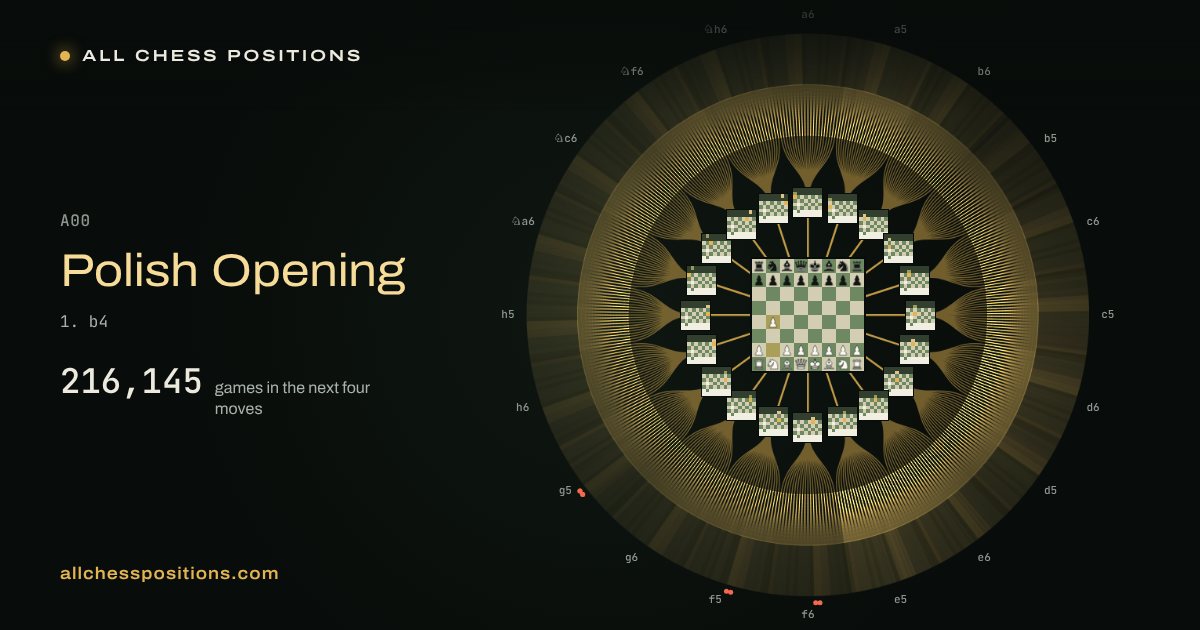
Black is to move and has 20 legal moves. Over the next four moves — two for each side — the game can branch into 216,145 different games. Those games reach 78,264 different positions: most positions can be reached in more than one way, 2.8 on average.
The Lichess opening list names 26 further lines after this position, such as with d5 (1... d5) and Outflank Variation (1... c6).
What Stockfish says
Stockfish 19 scores this position at −0.27 for White: Black is slightly better. The search looked at 20 million positions (nodes) and reached depth 36. Its best line: 1... e5 2. Bb2 Bxb4 3. Bxe5 Nf6 4. c3 Be7 5. Bxf6.
| Reply | Name | Score |
|---|---|---|
| 1... e5 engine’s choice | — | −0.27 |
| 1... d5 | with d5 | −0.19 |
| 1... e6 | — | −0.11 |
| 1... Nf6 | — | −0.07 |
Scores are from White’s point of view, in pawns: + means White is better. The other replies are scored with 2 million nodes each, the engine’s choice with the 20 million of the position above, so differences under about 0.3 are within the engine’s noise. All twenty first moves, ranked by Stockfish.
Move by move
- 1. b4Polish Opening
Named lines from here
- with d5A001... d5
- Outflank VariationA001... c6
- King's Indian VariationA001... Nf6 2. Bb2 g6
- Queenside DefenseA001... e6 2. Bb2 Nf6 3. b5 a6
- Birmingham GambitA001... c5
- Dutch DefenseA001... f5
- Grigorian VariationA001... Nc6
- Karniewski VariationA001... Nh6
- Symmetrical VariationA001... b5
- Bugayev AttackA001... e5 2. a3
- Czech DefenseA001... e5 2. Bb2 d6
- Wolferts GambitA001... e5 2. Bb2 c5
- Bugayev Advance VariationA001... e5 2. Bb2 f6 3. b5
- Tartakower GambitA001... e5 2. Bb2 f6 3. e4
- Queen's Indian VariationA001... e6 2. Bb2 Nf6 3. b5 b6
- Schiffler-Sokolsky VariationA001... e6 2. Bb2 Nf6 3. b5 d5 4. e3
Related openings
- King's Pawn GameB001. e4
- Queen's Pawn GameA401. d4
- English OpeningA101. c4
- Zukertort OpeningA041. Nf3
- Bird OpeningA021. f4
- Nimzo-Larsen AttackA011. b3
- Hungarian OpeningA001. g3
- Van Geet OpeningA001. Nc3
- Van't Kruijs OpeningA001. e3
- Mieses OpeningA001. d3
Chess by the numbers
FEN
rnbqkbnr/pppppppp/8/8/1P6/8/P1PPPPPP/RNBQKBNR b KQkq - 0 1