B00Opening
Nimzowitsch Defense
1. e4 Nc6
White to move
- Legal moves
- 30
- Games in the next 4 moves
- 475,842
- Different positions among them
- 163,549
- Named lines from here
- 43
Named after Aron Nimzowitsch: 1...Nc6 develops a knight and invites White to take the centre.
It is reached after 2 moves: 1. e4 Nc6.
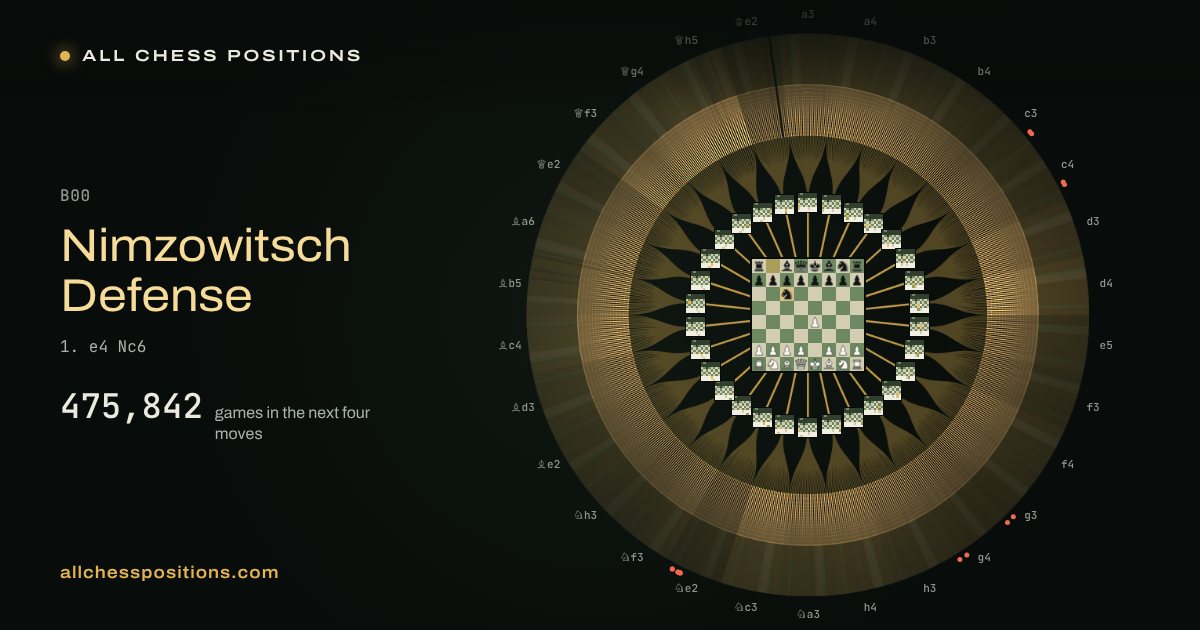
White is to move and has 30 legal moves. Over the next four moves — two for each side — the game can branch into 475,842 different games. Those games reach 163,549 different positions: most positions can be reached in more than one way, 2.9 on average.
The Lichess opening list names 43 further lines after this position, such as Declined Variation (2. Nf3) and Pseudo-Spanish Variation (2. Bb5).
What Stockfish says
Stockfish 19 scores this position at +0.51 for White: White is slightly better. The search looked at 5 million positions (nodes) and reached depth 29. Its best line: 2. d4 d5 3. e5 Bf5 4. c3 e6 5. Nd2 f6.
| Reply | Name | Score |
|---|---|---|
| 2. d4 engine’s choice | Nimzowitsch Defense | +0.51 |
| 2. Nf3 | Declined Variation | +0.18 |
| 2. Nc3 | — | +0.12 |
| 2. Bb5 | Pseudo-Spanish Variation | −0.07 |
Scores are from White’s point of view, in pawns: + means White is better. The other replies are scored with 2 million nodes each, the engine’s choice with the 5 million of the position above, so differences under about 0.3 are within the engine’s noise.
Move by move
- 1. e4King's Pawn Game
- 1... Nc6Nimzowitsch Defense
Named lines from here
- Nimzowitsch DefenseB002. d4
- Declined VariationB002. Nf3
- Pseudo-Spanish VariationB002. Bb5
- Wheeler GambitB002. b4
- French ConnectionB002. Nc3 e6
- Pirc ConnectionB002. Nc3 g6
- Breyer VariationB002. Nc3 Nf6 3. d4 e5
Related openings
- King's Pawn GameB001. e4
- King's Knight OpeningC401. e4 e5 2. Nf3
- King's Pawn Game: Wayward Queen AttackC201. e4 e5 2. Qh5
- King's Pawn Game: Napoleon AttackC201. e4 e5 2. Qf3
- Bongcloud AttackC201. e4 e5 2. Ke2
- Vienna GameC251. e4 e5 2. Nc3
- King's GambitC301. e4 e5 2. f4
- Bishop's OpeningC231. e4 e5 2. Bc4
- Center GameC201. e4 e5 2. d4
- Sicilian DefenseB201. e4 c5
Chess by the numbers
FEN
r1bqkbnr/pppppppp/2n5/8/4P3/8/PPPP1PPP/RNBQKBNR w KQkq - 1 2