A40Opening
Englund Gambit
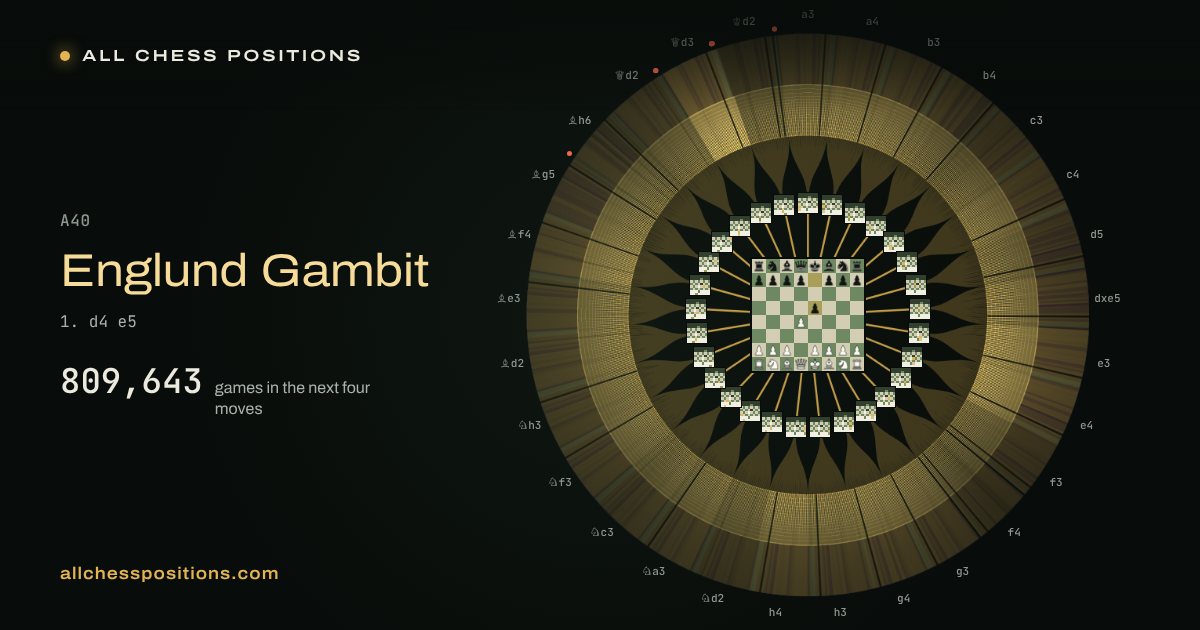
1. d4 e5
White to move
- Legal moves
- 29
- Games in the next 4 moves
- 809,643
- Different positions among them
- 275,497
- Named lines from here
- 15
Named after the Swedish player Fritz Englund. 1...e5 gives a pawn and sets a famous trap: 2. dxe5 Nc6 3. Nf3 Qe7 4. Bf4? Qb4+ 5. Bd2 Qxb2 6. Bc3? Bb4 7. Qd2 Bxc3 8. Qxc3 Qc1#.
It is reached after 2 moves: 1. d4 e5.
White is to move and has 29 legal moves. Over the next four moves — two for each side — the game can branch into 809,643 different games. Those games reach 275,497 different positions: most positions can be reached in more than one way, 2.9 on average.
The Lichess opening list names 15 further lines after this position, such as Englund Gambit Declined, Reversed Alekhine (2. Nf3) and Englund Gambit Declined (2. d5).
What Stockfish says
Stockfish 19 scores this position at +1.47 for White: White is better. The search looked at 5 million positions (nodes) and reached depth 24. Its best line: 2. dxe5 Nc6 3. Nf3 d5 4. Bf4 h6 5. h4 Bg4.
| Reply | Name | Score |
|---|---|---|
| 2. dxe5 engine’s choice | — | +1.47 |
| 2. Nf3 | Englund Gambit Declined: Reversed Alekhine | −0.26 |
| 2. d5 | Englund Gambit Declined | −0.16 |
| 2. e3 | Englund Gambit Declined: Reversed French | +0.18 |
Scores are from White’s point of view, in pawns: + means White is better. The other replies are scored with 2 million nodes each, the engine’s choice with the 5 million of the position above, so differences under about 0.3 are within the engine’s noise.
Move by move
- 1. d4Queen's Pawn Game
- 1... e5Englund Gambit
Named lines from here
- Englund Gambit Declined, Reversed AlekhineA402. Nf3
- Englund Gambit DeclinedA402. d5
- Main LineA402. dxe5 Nc6 3. Nf3 Qe7
- Englund Gambit Declined, Reversed FrenchA402. e3
- Hartlaub-Charlick GambitA402. dxe5 d6
- Mosquito GambitA402. dxe5 Qh4
- Soller GambitA402. dxe5 f6
- Felbecker GambitA402. dxe5 Nc6 3. Nf3 Bc5
- Soller Gambit DeferredA402. dxe5 Nc6 3. Nf3 f6
- Zilbermints GambitA402. dxe5 Nc6 3. Nf3 Nge7
Related openings
- Queen's Pawn GameA401. d4
- Queen's GambitD061. d4 d5 2. c4
- Indian DefenseA451. d4 Nf6
- Benoni Defense: Old BenoniA431. d4 c5
- Old Indian DefenseA411. d4 d6 2. c4
- Dutch DefenseA801. d4 f5
- Queen's Pawn Game: London SystemD021. d4 d5 2. Nf3 Nf6 3. Bf4
- Queen's Pawn Game: Accelerated London SystemD001. d4 d5 2. Bf4
- Rapport-Jobava SystemD011. d4 d5 2. Nc3 Nf6 3. Bf4
- Queen's Pawn Game: Colle SystemD041. d4 d5 2. Nf3 Nf6 3. e3
Chess by the numbers
FEN
rnbqkbnr/pppp1ppp/8/4p3/3P4/8/PPP1PPPP/RNBQKBNR w KQkq - 0 2