Copenhagen, 1923
The Immortal Zugzwang Game
Friedrich Sämisch – Aron Nimzowitsch · 0-1
- Result
- 0-1
- Moves
- 25
- The names end at
- 7... d5
The story
Played in Copenhagen in March 1923, in a Queen’s Indian Defense. Nimzowitsch, one of the great thinkers of the game, slowly takes over the kingside and the f-file.
After 25...h6 the board is still full of pieces, yet White has no useful move: every move loses something. Nimzowitsch wrote that White “has not a move left”, and Sämisch resigned.
Zugzwang — being forced to move when any move makes things worse — usually happens in endgames. Here it decides a middlegame, which is why Danish players called it the Immortal Zugzwang Game.
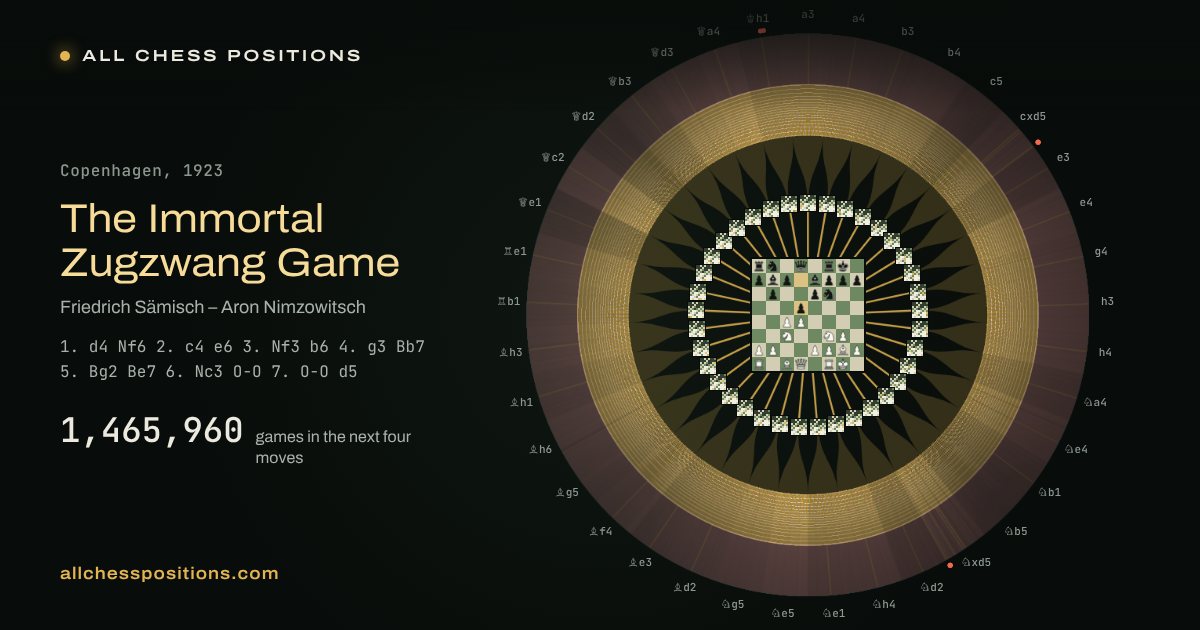
The moves
1.d4 Nf6 2.c4 e6 3.Nf3 b6 4.g3 Bb7 5.Bg2 Be7 6.Nc3 O-O 7.O-O d5 8.Ne5 c6 9.cxd5 cxd5 10.Bf4 a6 11.Rc1 b5 12.Qb3 Nc6 13.Nxc6 Bxc6 14.h3 Qd7 15.Kh2 Nh5 16.Bd2 f5 17.Qd1 b4 18.Nb1 Bb5 19.Rg1 Bd6 20.e4 fxe4 21.Qxh5 Rxf2 22.Qg5 Raf8 23.Kh1 R8f5 24.Qe3 Bd3 25.Rce1 h6 0-1
Through the openings
- 1. d4Queen's Pawn Game
- 1... Nf6Indian Defense
- 2. c4Indian Defense: Normal Variation
- 3. Nf3Indian Defense: Anti-Nimzo-Indian
- 3... b6Queen's Indian Defense
- 4. g3Queen's Indian Defense: Fianchetto Variation
- 4... Bb7Queen's Indian Defense: Fianchetto Variation, Traditional Line
- 5... Be7Queen's Indian Defense: Traditional Variation
- 6. Nc3Queen's Indian Defense: Anti-Queen's Indian System
- 7. O-OQueen's Indian Defense: Classical Variation, Traditional Variation
- 7... d5Queen's Indian Defense: Classical Variation, Traditional Variation, Nimzowitsch Line
Source of the moves: en.wikipedia.org